Sunday, February 21, 2010

Zambala Prayer (Wealth Deity Prayer)

正月初八


In Tibetan Buddhism, there is a diety called Zambala. Zambala is considered a wealth diety. The following is the translation of prayer which was extracted from the Barchey Kunsel Treasure of Chokgyur Lingpa called Lama Norlha, by Dazang Rinpoche and put in English by Pema Kunsang, June 1984.


Lama Norlha Padmasambhava - Zambhala Prayer

OM
Dogu chog tsol ngodrub ter / Tsasum kundu yishin nor
Guru pema sambhava / Rigshi gonpo dzam bhala
Nordag nojin jigten kyong / Jewa samgyi mi khyab pey
Kyilkhor lha tsog thamchey la / Chag tsal choto solwa deb
Jingyi lobshig barchey sol / Ngodrub tsol chig longcho pel
Tendir shug shig trinley dzo / Khordey kungyi leg tsog dang
Nokyi getsen chukyi yang / Lha mi lu dang nojin gyi
Zeynor rinchen jorpey trin / Changshey tadang kangshi chug
Lotog zudang tsi shing men / Tshering neymey trashi pal
Cho dang rigkyi gyu dzin sog / Dorna sizhi phuntshog kun
Beypa meypar wangdu du / Dzaymey chuwoi gyuntar pel
Chi sam yizhin drubpa dang / Trashi dekyi denpar dzo

OM
Bestower of supreme needs, giver of accomplishments,
Embodiment of all the three roots, wishfulfilling jewel,
Lotus Born Master,
Zambhala lords of the four families,
Wealth lords, yakshas, protectors of the world,
In an inconceivable amount of millions,
To this whole assembly of mandala deities,
I prostrate, offer, praise, and supplicate.
Please bless me and clear away obstacles.
Please bestow the siddhis and increase wealth.
While seated here, please fulfill the activities.
All what is excellent of both samsara and nirvana,
The goodness of the world, the prosperity of the beings,
Of gods, humans, nagas, and yakshas,
The foods, wealth, jewels, and a cloud of enjoyments,
All-knowing horses and four-legged cattle,
Crops, grains, herbs, plants and medicines,
Long lifespan, no illness, auspiciousness and splendor,
Lineage holders of both dharma and family, and so forth,
In short, all what is perfect of samsara and nirvana,
Make it effortlessly mastered,
Increase it like the inexhaustible flow of a river,
Make whatever I wish be fulfilled,
And let there be auspicious happiness!


-Mantra-
Om hung tram hrih ah dzambhala dzalendraye soha
Sarva yaksha basupati lokapala tsitta bring bring dzah
Sarva basu siddhi du du puting kuru soha

Zambala is the embodiment of all buddhas and bodhisatva wealth essence. We practise zambala to help ourselves to increase our wealth essence that can be transform into opportunities to practise dharma besides gaining wealth. In fact, I believe that to be rich is easier than to gain liberation within a lifetime. We can see around us many rich people all over the world, the millionaires and the billionaires. But it is very rare to find many people gain liberation within one lifetime. This is like the stars shining in the sky in day time.

We need a lot of merits (福) for practising dharma, and getting teachings and instructions from authentic masters. To gain realisation and liberation, we need more merits (福). As one of my masters put it, “ We need patience to practice dharma. But to have patience, we need merits.”

Wednesday, February 10, 2010

13. Om Mani Pad Me Hung - My personal episode


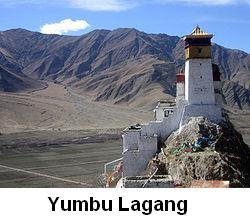
The King of Tibet, Lha Thothori Nyantsen who built the “Yumbu Lagang” received the Mantra “ OM MANI PAD ME HUNG”. He received it in a mysterious way. One day,while he was sitting in the "Yumbu Lagang" contemplating deeply how to help his citizens to live a happier life, a small box containing the Mantra - Om Mani Pad Me Hung - suddenly appeared in his hand. Then a voice from the sky told him that a king, born 5 generations later than him would understand the meaning of the Mantra.

King Songtsen Gampo was the king born 5 generations after King Lha Thothori Nyatsen. Through the sincere effort of King Songtsen Gampo, the profound meaning of Om Mani Pad Me Hung was well understood and being propagated throughout Tibet. Until today we can see the tremendous effect of this mantra being woven into the life of every Tibetan.

OM MANI PAD ME HUNG is the mantra of Chenrezig (观音–Kuan Yin). It is believed by the Tibetan that chanting the Mantra “Om mani pad me hung “aloud or silently bring tremendous benefits to oneself and others as a whole. I have personal experiences of receiving tremendous blessings from Chenrezig ( Kuan Yin ) after practicing meditation with this mantra. I shall relate one of the many good experiences of blessings from Kuan Yin.

In 1985, a Rinpoche (Tibetan Lama) visited my home town. I related to the Rinpoche a dream I had in the previous night. “I dreamt that there was a fierce green dragon residing in the lake 0f my home town. This dragon originated from South China Sea long time ago. Because of sinking many ships and killing many people in South China Sea, Kuan Yin decided to subdue this dragon and put it into this lake in my home town.” So Rinpoche suggested to me to place a Naga Vase into this lake, and I should be the one to put the vase. I knew that this lake (Merdeka Lake at Bukit Pasir of Batu Pahat town) was not safe to swim because many people had died in this lake. Hence, I brought along with me a rubber tube.

Rinpoche was doing puja at the side of the lake. I went towards the lake taking the Naga Vase with me. I swam alone with the rubber tube to the middle of the lake. I dived into the bottom of the lake and placed the vase there. I floated up. The rubber tube was a short distance away from me. I swam towards it but it started to move away from me. So I swam harder trying to grab the tube. However much I tried, I could not grab it. After a while, I was out of breath. I tried to call for help but I had no strength left. I felt my four limbs weakened and softened. They seemed like separating from my body. I slowly sank down. My mind was blacking out. Nobody came to help me as they do not know what had happened.

I thought, “This is the end of my life……” and somehow I chanted in my mind “Om mani pad me hung

Suddenly my hands and legs straightened out! I shot up to the surface of the water like a rocket, and surfaced right in front of the rubber tube! I grabbed the tube, breathing heavily. “Ah, I’m saved now.” A miracle had happened. Kuan Yin had saved my life!

Thursday, November 12, 2009

12. Time is running out

Do you know that Time is running out ?
Why we have to know about this ?
Because "Time is Money" everybody says this, isn't it ?

Time is running out, are you aware of it ?

"Why should I care?
I always have 24 hours a day and 365 days a year.
I never have to pay anything for the Time given to me."

"Hi, but you have forgotten one thing, though you never pay for Time,
Time is running you down moment by moment,
By the Time you realise, you are dying, too weak to do anything,
And soon you don't have the 24 hours and 365 days !"

To avoid being run down by Time, moment by moment in our life,
we have to.... Wake up and STOP having NON- Dharma Thoughts and Non-Dharma Activities!

Saturday, October 10, 2009

11. Just to Ponder 2

Since we have a life which is given free to us, and the time given free to us, logically speaking, every one of us should be able to enjoy a good life.

However, most of us are not able to have a good life because of our own defilements. We have many complaints about our parents. Many people have blamed their parents for their failures. Some of us even point a finger at our parents for our sufferings. In this way, we can’t feel grateful towards our parents for the life they given us.

Have you ever wondered how much pain your mother had gone through when she was conceiving you in her womb for 9 months ? How much pain she had to bear during the time of delivering you? Have your mother grumbled to you about those pains she had gone through?

Have you contemplated and thought deeply about the way your mother have taken care of you when you were one day old, one month old, and one year old? How your mother have nursed you and taught you when you were an infant? She had cared for you, didn’t she? You wouldn’t have survived without her care for you with great loving kindness and compassion, would you?

We were hopeless when we were still an infant. Our parents nursed us, loved us, warmed us, fed us and cared for us with great tenderness when we were few months old. Have you felt grateful towards your parents? Without their loving kindness and compassion, will you survive till today?

Have you ever thought of repaying your parents’ effort of taking care of you? Without the sense of feeling grateful towards your parents, you may not try to repay their loving kindness and compassion give to you by them.

Do you think we should feel grateful towards our parents, and try to repay them for their efforts of taking care of us, in any way we can?

Wednesday, September 9, 2009

10. Just to Ponder

Have you wondered that when we took birth, we did not use a credit card or an ATM card or wrote a cheque for our birth? Our parents paid everything. We did not have to pay anything. We just came out from mother womb free of charge. Have your parents ever asked you to pay back the expenses for your birth? We are given a life free of charge, isn’t?

How come we have messed up our lives in dissatisfaction? Our credit cards are in bad shape. We are not at peace with ourselves. We hardly live a life we wanted. We have struggled all these years and what is the result now?

We have never paid for the time we have spent in this life. Each one of us is given 24 hours a day and 365 days a year free of charge. What have we done with our time to end up our life in this way? What are the mistakes we have done? Do we have the time to remedy it now?

Sunday, July 5, 2009

9. How Buddhism started in the Land of Snow-Tibet


More than 2000 years ago, the Tibetans were living in small groups or small villages in the mountains. Later, a town was formed in the Kongpo area, also known as the “Monkey Nose” It was situated at the southern part of Tibet. It was the first Tibetan town. Tibet did not have a king then. There were village headmen only.

On one fine day, news spread around in the town that there was a very special person had appeared in the mountain. The people flocked into the mountain to meet this very special person. And that person was actually a prince from India. He was from a royal family known as "Lib-Stham-Bee", a very special race, known as the race of the Deva, the gods.

This prince was actually in exile from his country. He wandered around and happened to come to that area. He could not speak Tibetan language and neither those people speak his language. However, they noticed that he was a very special person. Since he was a prince, he has better appearance than them. So they were curious about him. They asked him where he had come from. Since he could not speak Tibetan, he just pointed his finger into the sky. Then the people thought that he was from the Devas. They bowed to him thinking that he was a Deva. They made a throne and carried him on their shoulders to the “Monkey Nose”. They appointed him as the king.

Since that time on, the monarchy system was well established in Tibet. Lha Thothori Nyantsen was the 26th king. "Lha" means the devas, the gods. Thothori Nyan was his name. He was a very special person. He had built the first palace in Tibet. It is known as “Yumbu Lagan” It was very well built. It is still there in Tibet.

This palace had a very unique design. It had a tower. On the top of the tower, there was a place where the king could sit and contemplate. On one fine day while he was sitting there with his hands folded together, a very strong feeling aroused inside him. He had a strong aspiration for wanting to do something meaningful for his people. He realized that he had not done enough by being just a good king but he did not know what it was. Amidst his strong feeling, suddenly from the sky, sounds and lights appeared and all aspects of incredible; it seemed like a little bit of a magical thing happening around him. He sat still, waiting anxiously. Suddenly, a shining cloud appeared. It moved down slowly towards him. Then he was totally covered by this shining cloud. He could not see anything at all. Then he felt something heavy was placed on his hands. After some time, the cloud disappeared and he remained sitting on the tower of his palace. In his hands there was a box. It looked special. He opened it. He was so happy when he saw a statue, a stupa, and a booklet written “OM MANI PEDME HUNG” a mantra. There was a voice telling him that in the future, a king, five generations from him, would understand the meaning of all those items in the box. So the king kept the box with those items inside with his utmost devotion and faith. That was the first connection for the Tibetan people with Avalokitesvara, (in Chinese- Kuan Yin ), the manifestation of the essence of loving kindness and compassion of all the Buddhas and Bodhisattvas. This event showed the manifestation, the blessing of Avalokitesvara specifically for Tibet and generally for the world.


Hence, this lineage had somehow started from this king Lha Thothori Nyantsen by receiving the auspicious box with those auspicious items in it. But later, after the 5th generations from him, a king called King Songtsen Gampo became the 1st in the line of kings in the Tibetan history.

King Songtsen Gampo is considered by the Tibetan as one of the manifestations of Avalokitesvara. By that time he had understood about the value of what his great, great, great grandfather had received from the manifestation of Avalokitesvara. In order for him to be able to learn and understand completely about this inheritance, he put lots of effort to bring the profound teachings of Buddha from India to Tibet. He was a great king. He became the king of Tibet when he was only 13 years old. Though he was so young, he conquered all over Tibet. Prior to this, there were many small kingdoms all over Tibet. Most of them were bandits, behaved like barbarians. So he united them as a sort of a united kingdom by conquering all of them.

After that, King Songtsen Gampo brought lots of profound teachings from all the neighboring countries; from China, Nepal and India. And he was able to cause Buddhism to flourish tremendously in Tibet when he married a princess from Nepal and a princess from China. These two princesses had brought along with them the most precious things - one Buddha statue from Nepal and one Buddha statue from China. And these two Buddha statues were most precious for Tibetan Buddhism until today. Besides the Buddha statues, they had also brought with them many texts of Buddha teachings. The Buddha statue which was brought by princess Wen-Cheng (文成公主) from China is highly venerated by all Tibetans until today. It was enshrined in the Jokhang Monastery in Lhasa (大昭寺)

From the teachings of the Buddha, King Songtsen Gampo had learnt about the causes of suffering of his people. He had learnt that they were suffering because they had 5 poisons i.e. desire, anger, ignorance, jealousy and pride. Those who had more of these poisons, they would have more sufferings. For those who had less poison in their mind, they would have less suffering. Happiness is not obtainable from the health, neither from their wealth, nor the fame. Happiness is obtained from our insight, the understanding or wisdom. As a result, he had understood that all the sufferings were caused by 5 poisons together with the stinginess as the 6th poison or in other words, the defilements in our mind.

He had also learnt the meaning of OM MANI PADME HUNG. This mantra is to pacify the obstacles of 6 poisons. There are 6 syllables in it and is able to help to develop the 6 special qualities out of the foundation of loving kindness and compassion. He propagated the OM MANI PADME HUM, the mantra of Avalokitesvara throughout Tibet..

To help to develop the essence of universal peace from Tibet, being the plateau of the world, King Songtsen Gampo combined the teaching of the Buddha and the great knowledge of ancient China which was the geomancy (风水), he built 108 stupas covering from Bhutan to Chengdu and also 12 main temples with a special one - the 13th temple . These stupas and temples were built on a very special location from Tibet to Bhutan and to Chengdu. The landscape, viewing from the sky, was like a human being lying on his back. The temples and the stupas were built on this human-like landscape in specific locations. He had built the special central temple in Lhasa on a lake named Milky Lake. It was a white lake, a very special one, and it was totally covered with earth. He had built this central temple there as his gratitude towards all the masters who had brought the Buddha dharma to Tibet and also to show his gratitude towards his queens who had brought the special Buddha statutes into Tibet. This temple was known as "Lhasa Thur Nam". It is still there. Thus, this action signified the beginning for creating the universal peace especially for mankind was nailed and established totally on the plateau of the earth.
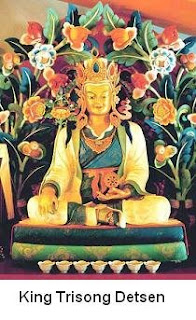

From then on, the strong establishment of Buddha dharma in Tibet had taken place. After another 6 generations had gone by, Trisong Detsen became the King of Tibet. He too was a great king. He invited Guru Padmasambhava to Tibet. Guru Padmasambhava was an Indian Mahasidha also known to the Tibetan as the Second Buddha. (He is commonly venerated as Guru Rinpoche by all the Buddhists who practice Tibetan Vajrayana Buddhism.) With the help of the occult power of Guru Rinpoche, King Trisong Detsen was able to complete the building of the first Buddhist monastery named "Samye Ling". It remains till today. Samye Ling is a holy place for pilgrimage.

Through the patronage of King Trisong Detsen, all the three yanas of Buddha Teachings; the Theravada, the Mahayana, and the Vajrayana were brought purely from India to Tibet where these Teachings slowly developed into 8 lineages. They were:1) Nyingma, 2)Kadam, 3)Lamdrey, 4)Marpa Kagyu, 5)Shangpa Kagyu, 6)Chicheh, 7)Dorje Sumjin and 8) Andrup. At present, there are 5 surviving lineages: 1)Ningma is Ningmapa. Kadam has divided into old Kadam and the new Kadam which known as 2)the Gelukpa. And 3)Lamdrey is the Sakyapa. 4)The Marpa Kagyu is the lineage in which the Karma Kagyu belongs to. The 5th lineage is the Shangpa Kagyu. Its lineage holder was the late V. Ven. Kalu Rinpoche. These are the five surviving lineages of Tibetan Vajrayana Buddhism. All the other 3 were somehow absorbed to these 5. There is no special separate lineage, but somehow they were absorbed into it. This is the way how Tibetan Vajrayana Buddhism fit to the present time and still surviving well. This is a brief history of Tibetan Vajrayana Buddhism.


Sunday, May 17, 2009

8. Karmapa

Here, we shall introduce about Karmapa which I mentioned in our article no.6. He is the head of Karma Kagyu Lineage in Tibetan Buddhism which we are following.

Tibetans revere Guru Rinpoche as the 2nd Buddha after Buddha Sakyamuni. And they believe that Karmapa is a manifestation of Guru Rinpoche. Tibetans also regard Karmapa as one of the manifestations of Bodhisattva Avalokitesvara (known as Kwan Yin in Chinese). The coming of Karmapa was predicted by Buddha Sakyamuni in the Samadhiraja (King of Samadhi) Sutra:

Two thousand years of my passing,
The teachings will spread in the land of the red faced ones,
Who will be the disciple of Avalokita;
The bodhisattva Simhanada, known as Karmapa, will appear.
Possessing mastery over Samadhi, He will tame beings
And establish them in bliss through seeing, hearing, recalling and touching.

Another prediction from Lankavatara (Manifesting in Lanka) Sutra:

Wearing monastic robes and a black crown,
He will perform unceasing benefit for beings
Until the teachings of one thousand buddhas disappear.

Karmapa is a very unique living personality. He is the founder of Tulku System (Incarnated Lama) in Tibetan Buddhism. The 1st Karmapa, Dusum Kyenpa left a written Letter predicting his future birth. The 2nd Karmapa, Karma Paksi, was found according to the descriptions in the Letter. Karma Paksi went to China by the invitation of Emperor of China during the Ming Dynasty. He performed 21 miracles during the first 21 days of His stay in the Palace. The Emperor of China became His disciple. From then on, all following Karmapas became the Gurus of Emperors of Ming Dynasty of China.

The 16th Karmapa was a great Bodhisattva. He received oral instructions and teachings mainly from His Root Guru, H.E. 11th Tai Situ Rinpoche. The 16th Karmapa’s Dharma activities spread far and wide. Many people in Europe and North America became Buddhists through just having a mere glimpse of Karmapa. Thus Tibetan Buddhism became flourished in Europe and North America. Many Dharma Centers sprung up like mushrooms all over the world. The 16th Karmapa had affected the lives of millions of people. My life changed for good after I took Refuge under The16th Karmapa.

The 16th Karmapa passed away in USA amid many wonderful signs. A few year prior to His Parinirvana, He left a letter with His Heart Disciple, H.E. The 12th Tai Situ Rinpoche who became the Root Guru of the present 17th Karmapa . The letter described about His future birth in details such as names of parents, year of birth, place of birth, and the signs after his birth. Thus the present 17th Karmapa was found without difficulty.

The 17th Karmapa, Urgyen Trinley Dorje was born in June 1985 in a nomad family in Kham, Tibet. When he was born, the neighbors heard the sound of conch-shell horn from the sky which lasted about 2 hours. This event was predicted in the 16th Karmapa's letter. The nomad's baby born with mysterious sound was named as Apo Gaga. When he was 6 years old, the search party for 17th Karmapa came to look for him by following the description in the prediction letter.

The 17th Karmapa was enthroned on 27th September, 1992 in Turphu Monastery, Tibet, with the recognition letter from the Central Committee of Communist China. And this was the first time the Communist Government of China recognized an incarnated Lama. If you wish to know more about Karmapa, please click this link: http://www.kagyuoffice.org/